

Which profiles can half-measures actually help?
Half-measures are not a matter of luxury. They are a matter of adjustment .
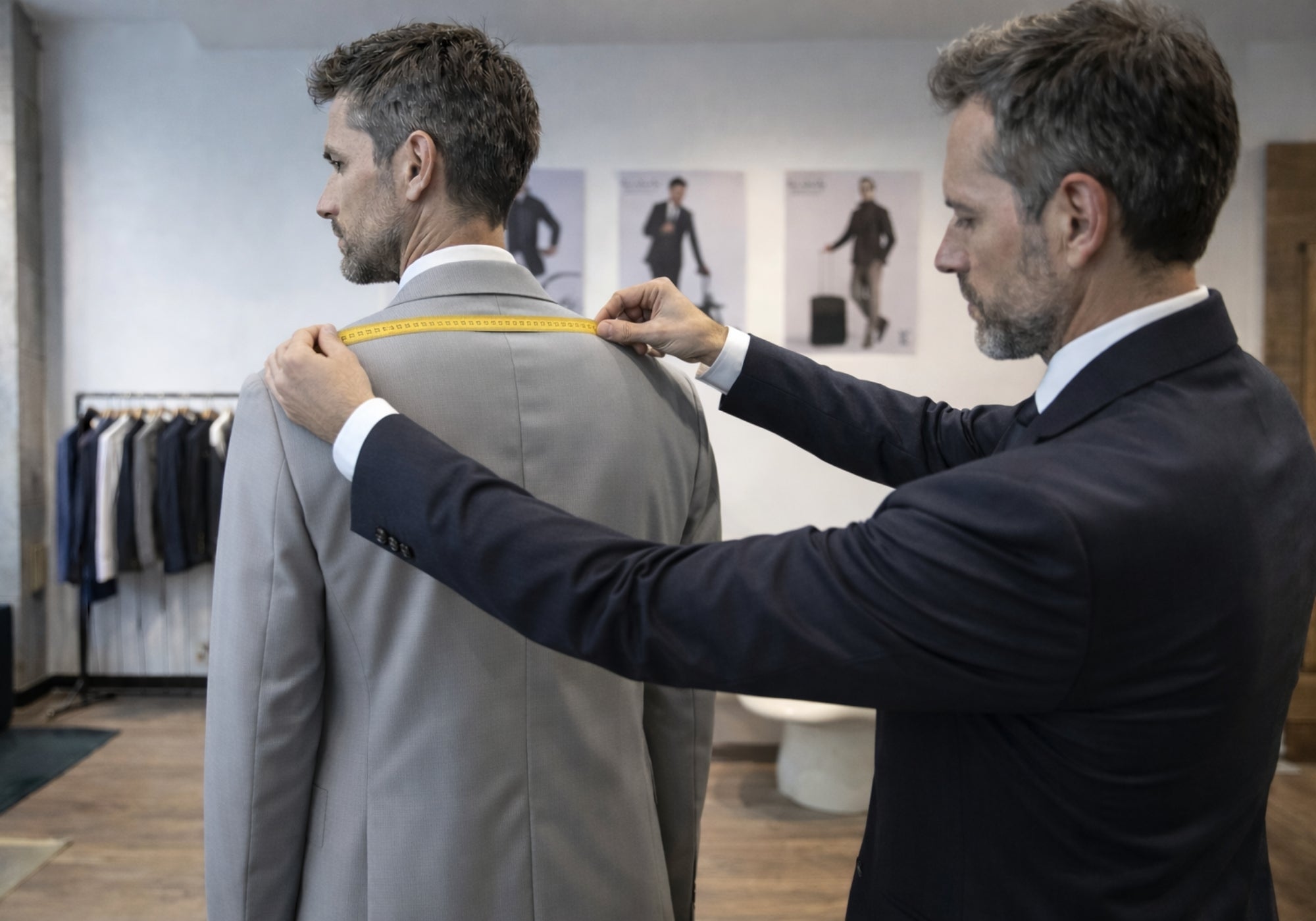
Most men don't exactly fit industry standards. Just a few deviations—posture, arch of the back, shoulder width, volume distribution—are enough to throw a garment off balance.
The half-measure allows these parameters to be adapted precisely, without creating an entirely new pattern.
But its appeal doesn't stop at "architecture." The tailor's expertise also allows them to recommend fabrics suited to your lifestyle and expectations. And to offer extensive customization of the garment: choice of finishes, accessories, and details. This creative dimension is just as important for men who want to feel good and stand out, even if just a little!
Here are the profiles for which it provides a particularly concrete benefit.
1) Tall and strong man
A tall man often encounters a simple problem: standard proportions are insufficient.
The sleeves look too short.
The jacket is too short.
The trousers cut off the silhouette.
When the build is more developed, there is sometimes added tension in the back, a lack of chest comfort or an imbalance between shoulders and waist.
The half-measure allows adjustment of the torso length, sleeve length, front/back balance, pant waist height and ease distribution.
The goal is not to enlarge the garment, but to restore a coherent line. 
2) Man with a belly
This is one of the most frequent cases.
In ready-to-wear clothing, the trousers fall below the belly, the belt tilts, the jacket opens and the back pulls.
The problem isn't the volume itself. It's the balance.
In semi-custom tailoring, the waist height, waist angle, front ease, and crotch depth are adjusted.
Properly fitting trousers immediately stabilize the silhouette.
The goal is not to conceal. It is to balance. 
3) Very thin man
Conversely, those with slim builds encounter other difficulties.
Excess volume in the back.
Sleeves too wide.
Jacket that hangs loosely at the shoulder blades.
The half-measure allows for refining the armholes, reducing the rear volume, adapting the leg width and better distributing the proportions.
The line becomes sharper, without rigidity.
Drooping shoulders or slightly hunched posture
A slight tilt of the shoulder is enough to create horizontal creases in the back, a collar that comes unglued, or a visual imbalance.
These adjustments remain invisible to the eye, but are crucial in the drape. 
4) Arms naturally held forward
Very common among active men (computer use, driving, frequent travel).
Without adjustment, the jacket pulls backwards, creases appear at the shoulder blades and mobility is reduced.
In a semi-custom approach, the sleeve angle is adjusted, the armhole is adapted, and the rear balance is corrected.
Clothing accompanies movement instead of restricting it.
5) Personalization: a creative and functional lever
Beyond morphological adjustment, semi-bespoke tailoring allows for true personalization.
The choice of fabric is crucial. It is not only a matter of aesthetic preference, but also of intended use.
A structured wool fabric will add structure to a slim silhouette.
A lighter wool will move more freely.
A technical fabric such as twisted wool will offer better resistance to creases and will be perfectly suited to a dynamic lifestyle.
The half-measure also allows for a choice:
– the lining
– the buttons
– the contrasts
– certain construction details
– the finishing touches
These elements are not superficial. They contribute to the overall coherence of the garment and its suitability to the personality and daily life of the wearer.
It's not about accumulating options. It's about creating a garment that aligns with its actual use.
6) So-called standard morphologies
Even without any marked particularity, the half-measure brings a benefit.
A better-calibrated waist height.
A more harmonious leg width.
A more precise overall balance.
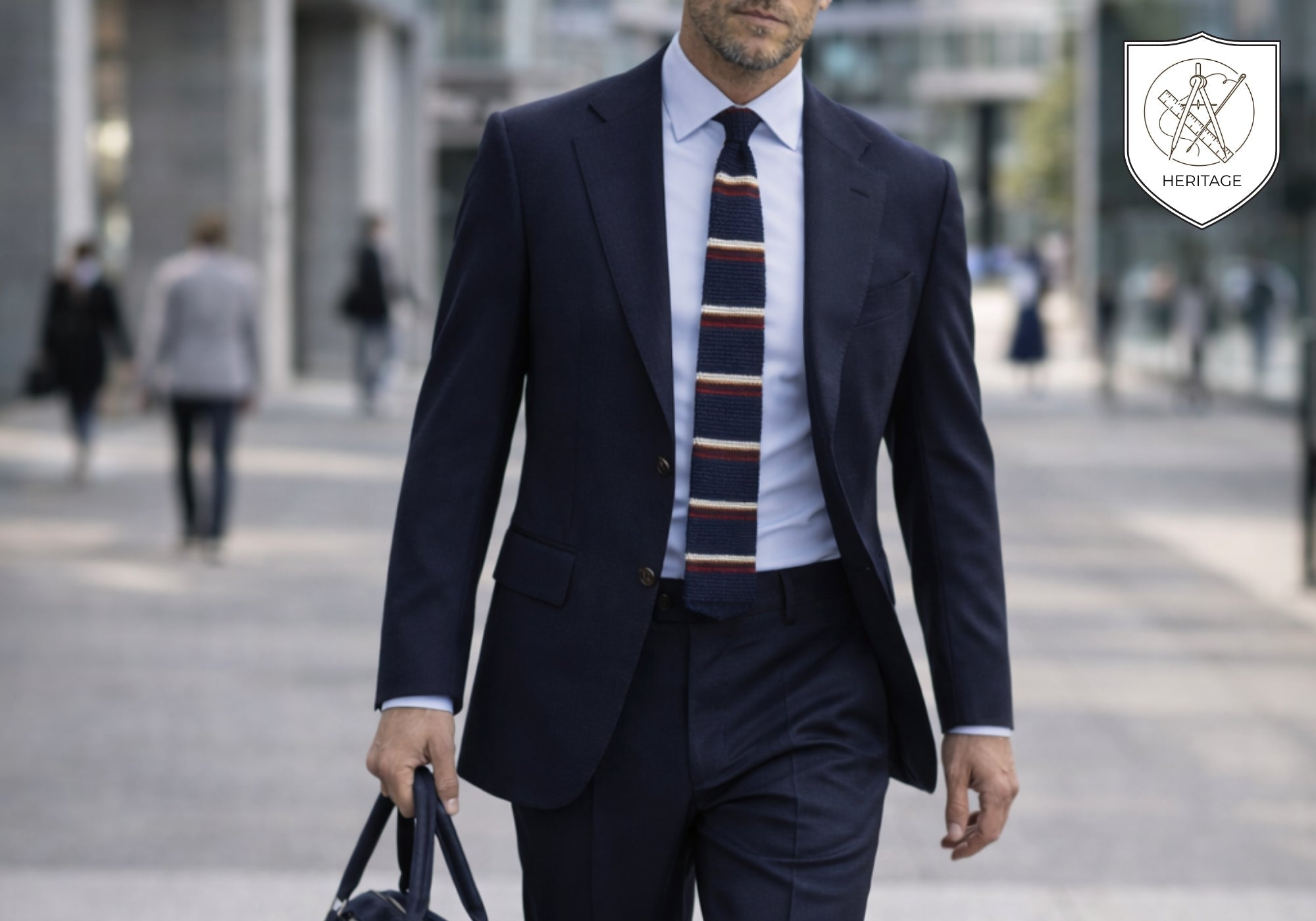
And the possibility of choosing a fabric or finish that is consistent with one's professional or personal environment.
It's not just about correcting. It's about refining and personalizing.
In summary
Half measures are not reserved for extreme cases.
It becomes relevant as soon as there is a difference, even a slight one, between your actual body shape and an industry average.
It helps to improve comfort, garment stability and silhouette balance.
But it also allows you to go further: choosing a material suited to your lifestyle, selecting consistent finishes, creating a truly personal garment.
It's not a spectacular transformation. It's an additional refinement, both technical and creative.
And it is often this precision that permanently changes the perception of a garment.

Written by yann behr


Leave a comment
This site is protected by hCaptcha and the hCaptcha Privacy Policy and Terms of Service apply.