
Article: Made-to-measure, made-to-measure, ready-to-wear: what are the differences?
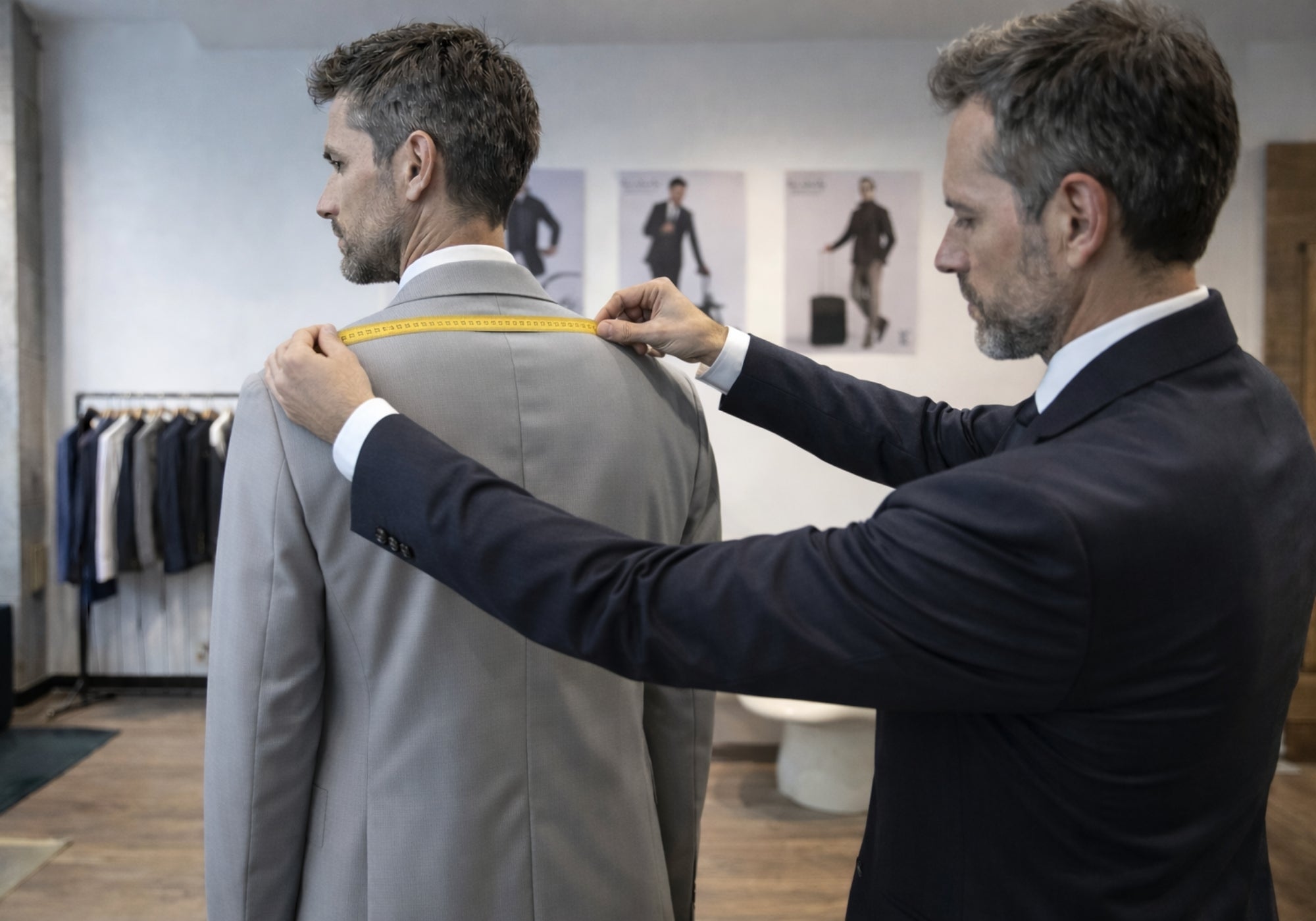
Made-to-measure, made-to-measure, ready-to-wear: what are the differences?
Before being commercial categories, these terms correspond to major developments in the history of men's clothing.
Understanding their origins allows us to better grasp what they imply today, and above all to make informed choices.
1) THE ORIGINS: THE BIRTH OF GRAND MEASUREMENT
For centuries, there was only one way to dress properly: go through a tailor.
Following in the footsteps of the weavers of northern England who are constantly improving their wool weaving techniques At the beginning of the 19th century, illustrious houses specialized in the making of costumes. In London, one street gradually became the world center of this craft: Savile Row, in the Mayfair district.

The houses that set up shop there developed a rigorous method: detailed measurements, creation of an individual pattern, several successive fittings, progressive adjustments.
The garment does not exist before the customer.
Each costume is designed for a specific body, posture, and silhouette. The construction relies on structured interlining, meticulous handwork, and a highly architectural pursuit of balance.
Savile Row thus becomes synonymous with bespoke tailoring: a complete artisanal approach, where the pattern is entirely created for the individual.
Other traditions also emerged. In Naples, the Italian school developed a more flexible and natural vision of costume in the 20th century: less structured shoulders, lighter construction, increased comfort.
The philosophy changes, but the principle remains the same: clothing is designed around the individual. This is the very essence of excellence, and an extremely valuable art.

2) The Industrialization and Rise of Ready-to-Wear Clothing
In the 19th century, industrialization profoundly transformed textile production.
Mass-produced military uniforms contribute to the standardization of sizes. Statistical averages are established from thousands of measurements. The first grading systems appear.
In the 20th century, ready-to-wear clothing developed massively. It democratized access to clothing. Its principle is simple:
– standardized sizes (48, 50, 52…)
– streamlined production
– immediate availability
Ready-to-wear clothing represents an economic and social revolution. It makes elegance more accessible. But it relies on averages. As soon as there is a discrepancy between actual body shape and the industry average, the limitations become apparent: tension in the back, sleeves that are too long, poorly balanced trousers.
And to satisfy the greatest number of people, the cuts but also the materials are becoming increasingly uniform.

3) THE HALF-MEASURE: CONTEMPORARY EVOLUTION
The half-measure emerges as an intermediate solution, as production and grading techniques improve.
Performed by professionals, it first allows for great precision in taking into account the client's physical characteristics. And then offers them a very wide range of customization options to make the piece unique.
Unlike the large-scale measure, the boss already exists.
The customer tries on a prototype that matches their size.
The tailor makes corrections by exception, based on what he observes, to achieve an ideal drape.
In practical terms, a made-to-measure tailor corrects and adjusts the following points:
– bust and sleeve length
– front/rear balance
– high or low shoulders
– prominent stomach
– arms too far forward or too far back
– comfort chest, back, thigh
– trouser waist height
– leg width
– certain parameters related to posture (hunched back, for example)
It is therefore the ideal compromise for the man who wants a unique piece, perfectly adapted to his body shape, at a competitive price.

This is precisely what led us at Wolbe to switch to this model: uniqueness and comfort. The modern man is mobile, active, and demanding. He seeks clothing that respects his silhouette, moves with him, and remains consistent with his daily life.
We realized that only a half-measure could optimize your comfort.
4) AND PERSONALIZATION?
This is the last remaining option. The aim here is to obtain a unique piece, without truly altering the garment's "architecture," as a tailor does with made-to-measure or semi-made-to-measure clothing. The expert eye is not involved, and the options are more limited.
You generally have control over the following points:
– essential measurements: sleeve length, back length, leg length
– fabrics (more or less supplied depending on the house)
– accessories: linings, buttons
– Finishing touches: pockets, sleeves, lapels, darts, contrasting collars
– Custom embroidery (text, thread color and placement) 
This is, for example, what we offer on the Wolbe website, when we provide you with parts to personalize via an online questionnaire.
CONCLUSION
Made-to-measure remains the most complete expression of the tailor's craft.
Ready-to-wear clothing offers immediacy.
Made-to-measure combines precise fit, personalization, and contemporary efficiency. For us, it's now the best solution. And we deliver it in partnership with a renowned workshop, as demanding as we are when it comes to fabric selection and the quality of finishes.
So if you'd like to create a costume project, feel free to visit us in store, 3 rue Chabanais, 75002. We'd be delighted to welcome you and assist you in the co-creation of your piece.

Written by yann behr


Leave a comment
This site is protected by hCaptcha and the hCaptcha Privacy Policy and Terms of Service apply.